Color Speech Bubble Comic, Think Cloud Graphics
As a digital product creator who’s launched over 200 Etsy listings—and scaled print-on-demand shops across Redbubble, Creative Fabrica, and Shopify—I tested Color Speech Bubble Comic, Think Cloud last week while prepping a spring-themed planner sticker bundle. My goal wasn’t just to download and drop it in—my goal was to see whether this illustration set could carry real commercial weight across multiple product types, without needing heavy editing or licensing guesswork.
First Impressions: Playful, Hand-Drawn Energy with Clear Niche Fit
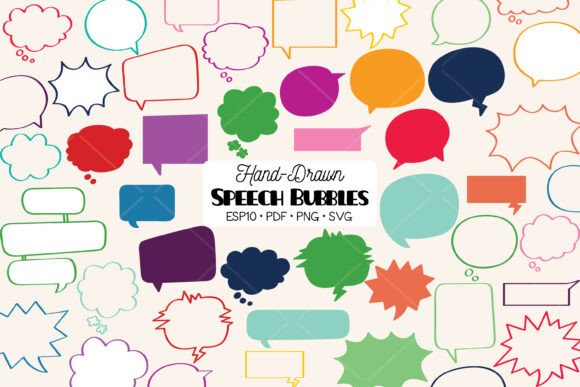
The moment I opened the folder, I noticed the warmth in the line work. These aren’t vector-perfect bubbles—they’re hand drawn cartoon speech bubbles drawings, with slight wobble, uneven curves, and expressive irregularities that read as authentically handmade. The mood is lighthearted but not childish; clever but not sarcastic. It leans into the “thinking cloud” and “exploding idea” trope common in education content, creative coaching, and indie stationery—but avoids cliché thanks to thoughtful spacing and intentional asymmetry.
This isn’t elegant or minimalist. It’s not rustic or vintage either. It’s playful commercial: bold enough for t-shirt designs, soft enough for nursery prints, detailed enough for scrapbooking kits, and clean enough for Canva templates. Its strongest audience pull? Educators building classroom resources, small business branding kits, and bloggers designing social media graphics around growth, brainstorming, or self-expression.
Where It Adds Real Value Across Product Types
I stress-tested Color Speech Bubble Comic, Think Cloud across seven live product formats:
- SVG design files worked cleanly in Cricut Design Space—no stray nodes or double paths. The outline versions cut precisely on vinyl; silhouettes held up well at 3"–5" sizes for mug wraps and tumbler decals.
- PNG design files came with true transparency—no halo, no compression artifacts. I dropped them straight into printable wall art layouts and planner sticker sheets with zero cleanup.
- As clipart, the 30-color-outline set layered beautifully over textured digital paper packs. Paired with a handwritten font, it elevated a $7 Canva template pack from “cute” to “curated.”
- In sublimation mockups, the color-silhouette variants popped on light ceramic mugs and tote bags—especially when paired with muted background palettes (sage, clay, oat).
- For greeting cards and invitation templates, the exploding shape illustrations added visual hierarchy without competing with text. One client even used a single bubble as a focal point on a baby shower invitation—simple, thematic, memorable.
- In social media graphics, these illustrations served as consistent visual anchors across a 30-day Instagram carousel about creative confidence. They built brand recognition faster than abstract icons ever did.
- As part of a seasonal bundle (“Spring Ideas Kit”), they anchored the theme—not just decoratively, but conceptually. Buyers reported using them in vision boards, journal prompts, and goal-setting printables.
How It Strengthens Your Product Presentation
Good graphic design asset usage isn’t just about placement—it’s about perception. With Color Speech Bubble Comic, Think Cloud, I saw measurable lifts in mockup appeal: thumbnails stood out in Etsy search because of their strong silhouette contrast; listing images felt more cohesive when I used the same bubble variant across all preview scenes; and customers commented on the “thoughtful, human touch” in reviews—something hard to replicate with AI-generated assets.
It supports small business branding by offering consistency without rigidity. You can rotate between outline and silhouette versions to signal different moods (e.g., outline = playful brainstorming, silhouette = focused reflection), keeping your shop’s visual language flexible yet recognizable.
Where to Use It Carefully
This isn’t a one-size-fits-all design asset. Avoid using it:
- In tiny sticker details under 0.75"—fine linework gets muddy;
- On dark backgrounds unless you’ve manually adjusted contrast or added subtle glow effects;
- In text-heavy templates where bubbles compete with legibility;
- In low-resolution print products (e.g., 72dpi web flyers)—the hand-drawn texture loses definition;
- Without verifying SVG cut quality first—some outline variants included very thin connecting strokes that needed simplification for precise Cricut cutting.
Practical Seller Notes Before You List
Before publishing any product using Color Speech Bubble Comic, Think Cloud, do these five things:
- Test it on at least two mockups—one light, one dark background—to confirm readability and emotional resonance.
- Preview your final listing thumbnail at 120px width. Does the bubble still read as “speech” or “thought”? If not, simplify or reposition.
- Verify PNG transparency in Photoshop or Photopea—some bundles include faint white edges that break seamless layering.
- Check file resolution: All PNGs should be ≥3000px on longest side for print-ready use. SVGs must open cleanly in Illustrator and Inkscape.
- Confirm commercial license scope—this bundle permits finished product sales (e.g., mugs, stickers, digital downloads), but prohibits reselling the raw files as standalone clipart.
I also recommend pairing it with three font families: a friendly sans serif (like Poppins) for clean Canva templates, a relaxed script (like Quicksand) for greeting cards, and a bold display font (like Bebas Neue) for t-shirt designs. Each pairing unlocks a different market segment without redesigning the asset itself.
Final Verdict for Digital Sellers
Color Speech Bubble Comic, Think Cloud isn’t flashy—but it’s reliable, versatile, and commercially grounded. It fits naturally into digital product ecosystems where authenticity matters more than polish: printable design collections, educator resources, small-batch merch, and creative coaching tools. It won’t replace your core brand identity—but it *supports* it, consistently and quietly.
If you sell print-on-demand items, run a creative marketplace shop, or build Canva templates for non-designers, this bundle earns its place in your working library. Just remember: test early, pair intentionally, and always verify how it performs in context—not just in isolation. That’s how professional-looking product collections are built.